Online money gaming can lead to financial loss, stress and compulsive behaviour. If play is affecting money, sleep, relationships or concentration, act early.
Borrowing, using credit or missing essential payments.
Hiding time, transactions or account activity.
Feeling restless or irritable when unable to play.
Increasing stakes to feel the same excitement.
Playing during work, study or sleep hours.
Continuing after deciding to stop.
02
A 24-hour pause plan
Close access.Log out, remove shortcuts and uninstall relevant apps.
Block the route.Use website blockers and device restrictions.
Protect money.Lower payment limits and move essential funds out of immediate reach.
Tell someone.Share what is happening with a trusted person.
Do not recover losses.Treat money already lost as gone; another stake increases risk.
03
When another person is affected
Choose a calm time, describe specific changes you have noticed, and focus on safety rather than blame. Do not lend money to cover gaming debts or take control of accounts without consent. Encourage professional financial, mental-health or legal help where appropriate.
04
Immediate danger
If someone may harm themselves or another person, contact local emergency services now and stay with them if it is safe to do so. For financial fraud or account compromise, contact the relevant bank/payment provider and India’s official cybercrime channels promptly.
05
A note on age
This site does not use age language to imply that prohibited activity becomes acceptable after a birthday.
FAQ
Frequently asked questions
How do I stop chasing losses?
End access, protect remaining money, tell someone you trust and treat the loss as final rather than trying to recover it.
Can limits make gambling safe?
Limits can reduce exposure but cannot remove uncertainty, financial harm or legal restrictions.
What if someone is in immediate danger?
Contact local emergency services and stay with the person if it is safe.
Detailed responsible use, limits and support guide
A complete decision framework for 99exchange responsible-use limits, warning signs and support
Direct answer: Responsible use begins before a session: money that can be lost without affecting essentials, a fixed time boundary, no borrowing and a stop rule that cannot be raised after a loss. If gambling is causing distress, secrecy, debt or repeated chasing, stopping and seeking support is the priority.
Treat the subject as a decision file rather than a sales page. The goal is to collect enough reliable context to choose a safer next step, including the choice to stop. The page focus here is 99exchange responsible-use limits, warning signs and support. One positive sign never erases a serious contradiction. Evaluate identity, terms, credentials, money and responsible-use controls separately, then base the decision on the weakest material link.
Use evidence that can be revisited: exact hostnames, written terms, transaction references and official sources. Screenshots can preserve context, but they do not turn an unsupported claim into proof. 99exchange Guide does not receive passwords, OTPs, payment credentials or identity documents, and it cannot verify private account outcomes.
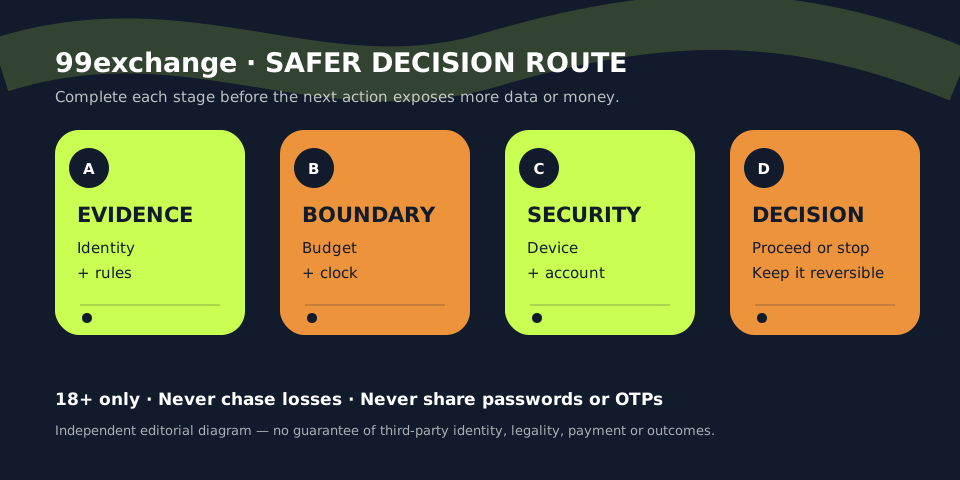
A four-stage review for 99exchange responsible-use limits, warning signs and support: verify the claim, set the boundary, protect sensitive data and pause when evidence is incomplete.
Terminology before action
Six terms that make this page easier to use
Definitions matter because a familiar word can create false confidence. Read the term together with the rule, screen or evidence that gives it meaning. If a third-party page uses different language, do not assume the outcome or obligation is unchanged.
01
Loss limit
The maximum affordable amount for a defined period, set before activity and never increased to recover money. In the context of 99exchange responsible-use limits, warning signs and support, use this term only as precisely as the applicable page or rule allows; similar labels can conceal different conditions.
02
Time limit
A fixed session boundary that includes breaks and prevents continuous play from becoming the default. In the context of 99exchange responsible-use limits, warning signs and support, use this term only as precisely as the applicable page or rule allows; similar labels can conceal different conditions.
03
Chasing
Increasing frequency, stake or time in an attempt to recover earlier losses. In the context of 99exchange responsible-use limits, warning signs and support, use this term only as precisely as the applicable page or rule allows; similar labels can conceal different conditions.
04
Cooling-off period
A deliberate pause that creates distance from urges and interrupts automatic re-entry. In the context of 99exchange responsible-use limits, warning signs and support, use this term only as precisely as the applicable page or rule allows; similar labels can conceal different conditions.
05
Self-exclusion
A stronger account-level barrier intended to prevent access for a chosen period where available. In the context of 99exchange responsible-use limits, warning signs and support, use this term only as precisely as the applicable page or rule allows; similar labels can conceal different conditions.
06
Support plan
Named people, services and practical barriers to contact when the stop rule becomes difficult to follow. In the context of 99exchange responsible-use limits, warning signs and support, use this term only as precisely as the applicable page or rule allows; similar labels can conceal different conditions.
A repeatable process
Step-by-step checklist
Follow these steps in order. Earlier checks are deliberately low commitment; later steps can expose identity, device access or money. Stop as soon as a material requirement is unclear or conflicts with your legal, financial or personal boundary.
Protect essential money
Separate rent, food, debt, health, education and savings before any entertainment budget exists. Complete this check before moving to a step that exposes more personal information or money. Record what you verified, where you found it and what remains uncertain.
Choose one loss ceiling
Set a number for the full period rather than allowing each session to appear small. Complete this check before moving to a step that exposes more personal information or money. Record what you verified, where you found it and what remains uncertain.
Set an end time
Use an external alarm and finish when it rings regardless of the current result. Complete this check before moving to a step that exposes more personal information or money. Record what you verified, where you found it and what remains uncertain.
Ban borrowing and chasing
Do not use credit, loans or another deposit to recover an earlier loss. Complete this check before moving to a step that exposes more personal information or money. Record what you verified, where you found it and what remains uncertain.
Add friction
Remove saved payment methods, mute promotions and use blocking or exclusion tools when needed. Complete this check before moving to a step that exposes more personal information or money. Record what you verified, where you found it and what remains uncertain.
Tell someone early
Share the plan with a trusted person before secrecy and financial pressure grow. Complete this check before moving to a step that exposes more personal information or money. Record what you verified, where you found it and what remains uncertain.
Escalate support
Seek qualified gambling-harm, mental-health, financial or emergency help according to the situation. Complete this check before moving to a step that exposes more personal information or money. Record what you verified, where you found it and what remains uncertain.
Compare the signal with the response
Decision table for 99exchange responsible-use limits, warning signs and support
Use the table to convert observations into actions. It avoids two common extremes: treating a small positive sign as total approval, or continuing to send information and money merely to resolve uncertainty.
What you observe
What it means
Safer next step
Essentials are fully protected
A budget may exist. This is a decision signal, not a complete safety verdict.
Keep the limit small and fixed. Keep the response within your pre-set money, time and privacy boundaries.
Loss prompts another deposit
Chasing has started. This is a decision signal, not a complete safety verdict.
Stop the session. Keep the response within your pre-set money, time and privacy boundaries.
Activity is hidden from family
Secrecy is a warning sign. This is a decision signal, not a complete safety verdict.
Tell a trusted person. Keep the response within your pre-set money, time and privacy boundaries.
Debt is funding play
The boundary is unsafe. This is a decision signal, not a complete safety verdict.
Stop and seek financial support. Keep the response within your pre-set money, time and privacy boundaries.
Distress feels immediate
Safety comes first. This is a decision signal, not a complete safety verdict.
Use local emergency or crisis help now. Keep the response within your pre-set money, time and privacy boundaries.
Risks worth spotting early
Common mistakes and why they matter
Most preventable harm begins with a shortcut: assuming the name proves identity, letting urgency replace verification, or redefining an affordable limit after a loss. These patterns are more important than small cosmetic differences between pages.
01
Calling loss an investment
Reframing uncertain gambling as income can justify money that is not affordable to lose. The practical correction is to pause, return to the relevant evidence and avoid making the next action larger simply because time has already been spent.
02
Resetting the limit after loss
A boundary that moves when tested is not functioning as a boundary. The practical correction is to pause, return to the relevant evidence and avoid making the next action larger simply because time has already been spent.
03
Using many small deposits
Fragmented transactions can hide the true weekly or monthly total. The practical correction is to pause, return to the relevant evidence and avoid making the next action larger simply because time has already been spent.
04
Playing to change mood
Stress, anger, loneliness and intoxication reduce the quality of decisions. The practical correction is to pause, return to the relevant evidence and avoid making the next action larger simply because time has already been spent.
05
Waiting for a crisis
Support and blocking tools are easier to use before debt, secrecy or distress becomes severe. The practical correction is to pause, return to the relevant evidence and avoid making the next action larger simply because time has already been spent.
Put the checklist into practice
Three realistic scenarios
Scenarios reveal how several risks combine. The details will vary, but a sound response usually slows the decision, separates the communication route from the verification route and keeps financial exposure from growing.
The limit is reached early
Situation: A session uses the full planned amount sooner than expected.
Safer response: Stop immediately. The speed of the loss does not create extra budget. Leave the account, remove the payment route and use the remaining time for an activity unrelated to gambling.
Notice the pattern: the response protects credentials, preserves a record and keeps the reader free to walk away. It does not promise that a disputed account, transaction or third-party service can be recovered.
A person starts hiding statements
Situation: Transactions are deleted or explained vaguely to avoid a difficult conversation.
Safer response: Treat secrecy as a reason to stop, not as a privacy technique. Share the situation with a trusted person and seek appropriate financial or gambling-harm support.
Notice the pattern: the response protects credentials, preserves a record and keeps the reader free to walk away. It does not promise that a disputed account, transaction or third-party service can be recovered.
An urge arrives after a loss
Situation: The user wants one more attempt to return to the earlier balance.
Safer response: Create distance: close the page, move away from the device, contact the named support person and keep the no-chasing rule intact. Loss cannot be made safer by increasing exposure.
Notice the pattern: the response protects credentials, preserves a record and keeps the reader free to walk away. It does not promise that a disputed account, transaction or third-party service can be recovered.
Evidence boundary
What this guide can and cannot establish
This 99exchange page can explain responsible use, limits and support for 99exchange responsible-use limits, warning signs and support, organise questions and show how to preserve useful records. It does not establish that a third-party domain is official, that an operator is licensed for a reader’s location, that a payment will be returned, or that any game outcome can be predicted.
Current details should be checked at the moment they matter. Terms, domains, app files, support routes and legal context can change. Prefer official primary material for changing public rules and use qualified professional advice when the consequences are material.
Keep sensitive information outside the research process. Redact passwords, OTPs, card security codes, recovery codes and unrelated identity data from any record you retain. If you suspect fraud or unauthorised access, use the official channel of your bank, payment provider, email service or relevant authority—not a number supplied by an unknown intermediary.
Clear answers
Frequently asked questions about 99exchange responsible-use limits, warning signs and support
What is the most important limit?
The total affordable loss ceiling matters most, supported by time limits and a no-borrowing rule. When a material fact is missing, keep the conclusion cautious and use the relevant internal guide to complete the next check.
Should a limit increase after a loss?
No. Increasing it to recover money is chasing. When a material fact is missing, keep the conclusion cautious and use the relevant internal guide to complete the next check.
When should someone seek help?
Seek support as soon as play causes distress, secrecy, debt, conflict, loss of control or repeated broken limits. When a material fact is missing, keep the conclusion cautious and use the relevant internal guide to complete the next check.
Are blocking tools enough by themselves?
They help, but stronger plans also involve money barriers, trusted people and professional support when needed. When a material fact is missing, keep the conclusion cautious and use the relevant internal guide to complete the next check.
What if immediate safety is at risk?
Contact local emergency or crisis services and a trusted person now; account questions can wait. When a material fact is missing, keep the conclusion cautious and use the relevant internal guide to complete the next check.
Related next steps
Continue with the guide that matches your task
Open one focused page, complete its checklist and keep your decision reversible. If uncertainty remains, stop rather than moving to a more sensitive or expensive action.
18+ · Financial riskOnline money gaming can cause serious loss and harm. India’s central law prohibits online money games and their promotion.Get support guidance
Keep control
Five rules before you leave this page
18+
Adults only
Do not participate if you are under 18 or otherwise ineligible where you live.
₹ / ⏱
Set money and time limits
Protect essentials first. Fix both limits before play and never raise them after a loss.
↛
Never chase losses
Do not borrow, redeposit or extend a session to recover money already lost.
••••
Protect password and OTP
Never share passwords, OTPs, recovery codes or banking secrets with an agent or guide.
?
Check jurisdiction and support
Confirm current local rules. If play causes harm, stop and use trusted local support.
Hello! 👋 Do you want to Create your IPL Cricket Betting ID ?
Kisi bhi top bookie (Reddy Anna, Lotus, etc.) se apni Betting ID lo, fatak se 60 seconds mein. Tension-free khelo kyunki humara 24/7 live chat support hamesha aapke saath hai.